

BUSINESS
NPL General Loans
We acquire general non-performing loans held by financial institutions and restore their value through professional recovery.
What is an NPL (Non-Performing Loan)?
An NPL generally refers to a delinquent loan classified as substandard or below ('substandard', 'doubtful', 'estimated loss') under the Forward Looking Criteria (FLC) of asset soundness classification — typically a loan delinquent for 3 months or more. It includes not only general delinquent claims but also restructured personal loans and corporate workout claims.
To secure financial soundness, commercial banks manage ratios such as the loan-to-deposit ratio (total loans/total deposits), delinquency ratio (substandard-and-below/total loans), and BIS capital adequacy ratio (equity/risk-weighted assets) — and they sell NPLs accordingly.
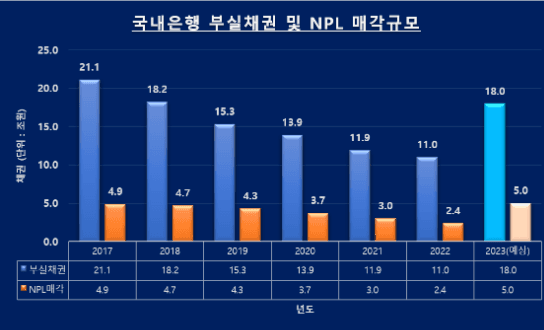
NPL sales generally increase during real estate downturns and recessions; large volumes were sold during the IMF crisis and the 2008 global financial crisis. NPL sale volume is expected to rise sharply from 2023.
Types of Claims
General Secured Loans
- Claims secured by real rights (mortgage, pledge, provisional registration, etc.)
- Mortgage loans, other secured loans
Unsecured Loans
- Pure unsecured claims
- Business/operating loans, credit cards, card-company credit claims
- Converted unsecured claims, residual assets after seizure
Process
Acquisition
- Financial institutions (1st/2nd tier)
- Lending corporations
Recovery
Resale (Assignment)
Reselling secured NPLs to FSC-registered lending corporations for early recovery
Auction (Dividend)
Receiving dividends through prompt enforcement of the security right (voluntary auction)
Discounted Repayment
When the debtor is willing to repay but the collateral value falls well short of the claim, inducing repayment by discounting the held claim
REO Sale (Take-over)
Directly winning collateral with future value at auction, raising its value through repurposing or remodeling, then selling to recover